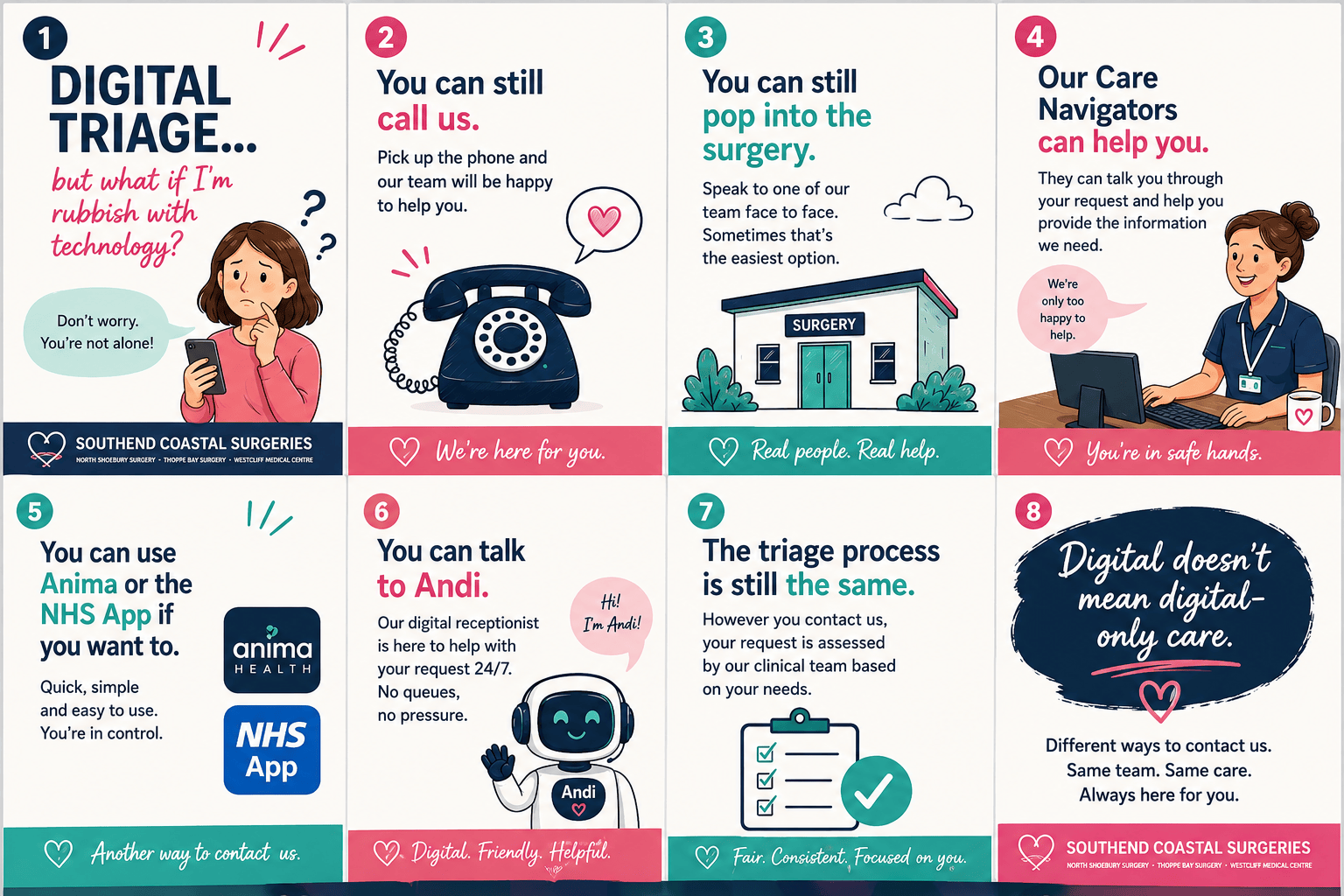

Digital triage has become part of everyday life in general practice, but let’s be honest, for many patients, it still feels a bit like sending a message into the void. You type out your symptoms, hit submit, and then… silence. What actually happens next? Who reads it? How do we decide what’s urgent? And is there really a human being behind the screen, or just a very tired robot with a stethoscope?
Time to lift the curtain.
Because behind every digital request is a real clinician, a real team, and a real process, powered by a team who care deeply, work ridiculously hard, and occasionally run on nothing but caffeine and determination.
We Didn’t Just Wake Up One Morning and Decide to Use Digital Triage
Digital triage isn’t something GP practices randomly decided to adopt because it looked modern or convenient. It’s part of a national NHS initiative called Modern General Practice Access — a programme designed to make care safer, reduce the 8 am phone rush, and ensure every patient’s request is clinically assessed the same day.
NHS England has been clear: digital triage is now the expected standard for managing demand in primary care. It helps practices spot urgent cases faster, direct patients to the right clinician, and make sure care is based on clinical need, not on who can get through on the phone first.
So no, we didn’t wake up one morning and think, “Let’s change everything.” This is a national shift in how general practice works, and we’re delivering it because it keeps patients safer and makes access fairer.
The Moment You Click “Submit” — We’re Already Moving
Your request doesn’t sit in a dusty inbox waiting for someone to notice it. It drops straight into our clinical triage list, which is monitored constantly throughout the day. Every single request is time-stamped, categorised, checked for risk, and assigned to the clinical triage team.
Nothing is ignored. And absolutely nothing is automated, unless you count the kettle, which is arguably the most overworked member of the team.
A Clinician Reads Every Word You Write
One of our clinicians reviews your request; sometimes we have to ask follow‑up questions or reconfirm details. Not to be annoying, not to delay your care, but because safe decision‑making depends on accuracy.
We double-check when reception has submitted the form on your behalf, and we want to make sure your voice is fully captured. We check when something doesn’t quite match your medical history, when your symptoms could indicate more than one possible issue, or when your answers are brief, and we need more detail to assess urgency.
It’s exactly what we’d do if you were sitting in front of us, just without the moment where you try to remember the exact name of the medication that was “blue… or maybe green… the one I had last year… you know the one.”
Safety First: How We Decide Urgency
Once your request is reviewed, the clinician decides what needs to happen next. That decision is based on clinical guidelines, your symptoms, your risk factors, your medical history, national safety standards, and the urgency of your condition.
Some cases need same‑day action. Some need routine appointments. Some need tests, prescriptions, monitoring, or advice. Every decision is made with safety at the centre, not speed, not convenience, and definitely not “who clicked first.”
Appointments Are Given Based on Clinical Need — Not First Come, First Served
This is one of the biggest misunderstandings.
Appointments are allocated by clinical priority, not by who woke up earliest or who has the fastest Wi‑Fi.
Urgent cases are seen urgently. Routine cases are booked appropriately. Some issues can be safely managed without an appointment. Some need tests before an appointment. Some need monitoring rather than a visit.
It ensures the right people are seen at the right time.
Behind the Scenes: The Triage Team Never Stops
While you go about your day, our triage team is reviewing new requests, responding to follow‑up questions, booking appointments, issuing prescriptions, arranging tests, coordinating with PCN services, checking for red flags, calling patients, supporting reception, supporting clinicians, and clearing the triage list.
And we do this every single day — not spinning plates, but more like running a relay race where the baton is patient safety, and nobody wants to drop it. The pace is constant, the focus is sharp, and the responsibility is huge.
The Human Side Patients Don’t See
Digital triage is clinical work, but it’s also emotional work. Our clinicians worry about your symptoms, double-check your history, discuss complex cases with colleagues, and call patients who seem vulnerable. They often work straight through their lunch to make sure no one is left waiting, and they stay late to finish triage safely because they feel the pressure of rising demand and genuinely care about getting every decision right.
And here’s something important: we’re human. We’re not perfect, but we are doing the very best we can — we’re working under enormous pressure with limited resources, rising demand, and a system that is stretched nationally. Kindness and patience make a huge difference. A rude comment or harsh tone can linger with a member of staff long after the call ends, but a bit of understanding can lift someone’s whole day.
We’re doing the very best we can with the resources we have, and every single person on our team comes to work wanting to help you. Compassion goes both ways, and when patients and staff treat each other with respect, the whole experience becomes safer, calmer, and better for everyone.
Why Digital Triage Makes Care Safer
Digital triage isn’t just about convenience; it’s about safety. It allows us to spot urgent cases quickly, prevent unsafe delays, prioritise those who need immediate care, reduce missed diagnoses, direct patients to the right clinician, manage demand fairly, and keep appointments for those who truly need them. It’s one of the strongest tools we have for delivering safe, modern general practice.
Why We Want You to Know All This
We want you to understand this process because trust comes from honesty. We want you to feel confident using digital triage, to know how hard our team works behind the scenes, and to see the human beings who care about every request that comes in. Digital triage isn’t a wall between you and us. It’s a safety net, a clinical support system, and one of the most effective ways we have to keep you safe in modern general practice.
Ready to take the next step?
At Southend Coastal Surgeries, we’re here to support you and your family with trusted, compassionate healthcare close to home. 💙
If you’re not already registered with us, why not make the move today? Join our practice and become part of the Southend Coastal Surgeries community.
👉 Visit our website to find out more and register: http://www.Southendcoastalsurgeries.co.uk
And if you enjoyed this blog, there’s plenty more to discover! Head over to our blog page: http://behindtheclinicdoor.business.blog for helpful health advice, practice news, useful tips and the latest updates from our team.
Your health matters. Let’s look after it together. 💙

