There are certain things women become experts at without ever being formally trained: carrying the emotional load of an entire household, remembering everyone’s birthdays, and pretending we’re absolutely fine when we’re actually running on caffeine and sheer determination. But there’s one thing many of us don’t become experts at and often avoid entirely, and that’s cervical screening.
For something that takes only a few minutes, the smear test has gathered a reputation worthy of a horror film. It’s whispered about, postponed, feared, and occasionally treated like a mythical event that only the bravest women attend. But the truth is far less dramatic, far more important, and — dare I say it — much gentler than the rumours suggest.
This blog is about demystifying cervical screening. About honesty. About dignity. About cultural sensitivity. And about our absolute commitment at Southend Coastal Surgeries (thorpebay, North Shoebury and Westcliff Medical centre) to making sure every woman feels safe, respected, and genuinely cared for.
Who should have a smear test? (Spoiler: almost everyone aged 25–64)
If you are aged 25 to 64, you should have cervical screening — even if:
- You feel perfectly healthy
- You have no symptoms
- You’ve had the same partner for decades
- You’re not currently sexually active
- You’re in a same‑sex relationship
- You’ve gone through menopause
- You’ve had the HPV vaccine
- You’ve never had a smear before
Cervical screening is about cell changes, not lifestyle. It’s a preventative test, not a reaction to symptoms.
And what if you’ve never had sex?
This is one of the most common questions we hear — especially from women from religious backgrounds, ethnic minority communities, or those who simply feel unsure.
Here’s the honest, gentle answer:
Even if you have never had sexual intercourse, you can still choose to have a smear test.
HPV is usually passed through sexual contact, but not exclusively through penetrative sex. It can be transmitted through skin‑to‑skin contact in the genital area. And while the risk is lower if you’ve never been sexually active, it isn’t zero.
More importantly: Cervical screening isn’t just about HPV — it’s about checking the health of the cervix itself.
Many women who have never had sex still choose to attend for reassurance, peace of mind, and a sense of control over their health. If you’re unsure, you can book an appointment just to talk it through. We will listen, explain, and support you without judgement.
Your body, your choice, your comfort.

Why we care so deeply
Cervical screening prevents around 70% of cervical cancers, and if every eligible woman attended, that number could rise to 83%. It doesn’t look for cancer — it looks for early cell changes long before they become dangerous. It’s one of the most effective preventative health checks available.
Five minutes of mild awkwardness for years of reassurance? That’s a bargain.
But we also know that logic doesn’t always win. Feelings do. And feelings around smear tests can be complicated — shaped by culture, religion, modesty, past experiences, trauma, embarrassment, or simply not knowing what actually happens.
So let’s talk about it properly.
Our promise to every woman — every background, every belief, every story
At Southend Coastal Surgeries, we are committed to ensuring that every woman feels safe and supported when accessing cervical screening. When we say every woman, we mean:
- Women from religious backgrounds where modesty is deeply valued
- Women from ethnic minority communities where smear tests may not be openly discussed
- Women who have experienced trauma
- Women who feel embarrassed or shy
- Women who have never had a smear
- Women who are overdue and worried
- Women who simply don’t know what to expect
Your dignity matters. Your comfort matters. Your culture matters. And we will adapt the appointment to you — not the other way around.
You can have a female clinician, bring someone with you, ask for a chaperone, or take things slowly. You are in control from start to finish.
So… what actually happens? The real, detailed, honest version
Let’s walk through the smear test step by step — calmly, clearly, and without the mystery.
1. You arrive and are welcomed
You’ll be greeted by a clinician who will explain everything before anything happens. You can ask questions, express worries, or talk through cultural or religious concerns. We listen — properly.
2. You’re shown to a private room
This is your space. The door is closed. You’re not rushed. You’re not expected to “just get on with it”. You can take your time.
3. You undress from the waist down
Behind a curtain. In privacy. You can keep your top on, your socks on, your dignity fully intact. Some women bring a long jumper or dress — that’s absolutely fine.
4. You lie on the couch
Usually with your knees bent and feet together, or legs slightly apart. You choose the position that feels comfortable. The clinician will check you’re ready before anything begins.
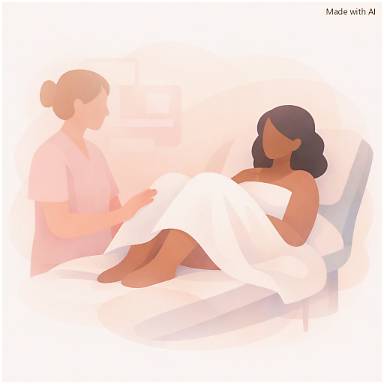
5. The speculum
This is the part everyone worries about, so let’s be honest: A speculum is a small, smooth device that gently opens the vaginal walls so the cervix can be seen. It’s not sharp. It’s not painful. It may feel a bit strange or pressure‑like, but it shouldn’t hurt. If it does, you tell us — and we stop.
We use plenty of lubrication, warm hands, and a calm pace. You can ask for a smaller speculum if you prefer.
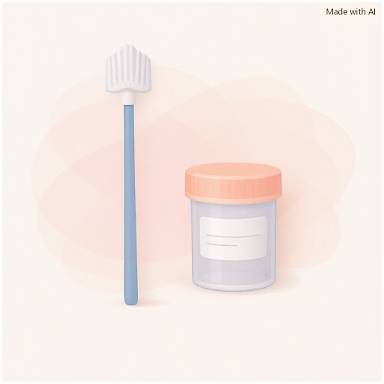
6. The sample
Once the cervix is visible, a soft brush is used to collect a few cells. It takes seconds. Most women describe it as “a tickle”, or “barely noticeable”.
7. You’re done
The speculum is removed gently. You get dressed. You can take a moment, breathe, chat, laugh, or ask questions. Many women say the same thing:
“Oh… was that it?”
8. Your results
Your sample is tested for HPV (the virus that can cause cell changes). If HPV is found, the cells are checked more closely. If HPV is not found, you’re usually clear for three to five years depending on your age.
Let’s talk about modesty, faith and cultural sensitivity
For some women, especially those from religious or ethnic minority backgrounds, cervical screening can feel deeply personal. Modesty, privacy, and cultural expectations matter — and we respect that completely.
Here’s what we do:
- Provide female clinicians
- Offer chaperones
- Allow you to bring a companion
- Give you time to talk through concerns
- Explain every step before it happens
- Stop immediately if you feel uncomfortable
- Maintain your dignity at all times
- Adapt the appointment to your needs
Your beliefs are respected. Your boundaries are honoured. Your comfort is our priority.
A few minutes that could save your life
Cervical screening isn’t glamorous. It isn’t fun. But it is powerful. It’s protective. It’s preventative. And it’s one of the most important things you can do for yourself.
We are here to make it as comfortable, respectful and reassuring as possible — for every woman, from every background, with every story.
Book your smear. Not because you “should”, but because you deserve care that keeps you safe.
And we’ll be right here, ready to welcome you with kindness, calmness, and maybe even a little humour to make the whole thing feel less awkward.
For more information or to join the surgery go to http://www.southendcoastalsurgeries.co.uk

